About
S3FNet was originally designed as a parallel discrete event network simulation framework. It accepts simulation models through dml files. Entities are aligned on logical constructs called timelines. Execution of timelines is synchronized using a composite synchronization algorithm which is a combination of barrier and appointment based synchronizations [link].
This is an extension of S3FNet to support co-simulated models i.e models of networked systems where some or all hosts are emulated while the underlying network is simulated. Synchronization between emulated and simulated Entities of the co-simulated model relies on the use of virtual time management tools.
VT-S3FNet can work with two virtual time systems Titan and Kronos to execute co-simulated models. This documentation describes how to specify and launch co-simulated models.

Figure 1. General architecture of parallel network simulation with S3FNet
Figure-1 shows the general architecure of simulating networks with S3FNet. Entities (hosts + routers) are aligned on timelines. Timelines are connected by channels. Entities aligned on timelines can send events to each other. A composite synchronization protocol synchronizes timelines execution.
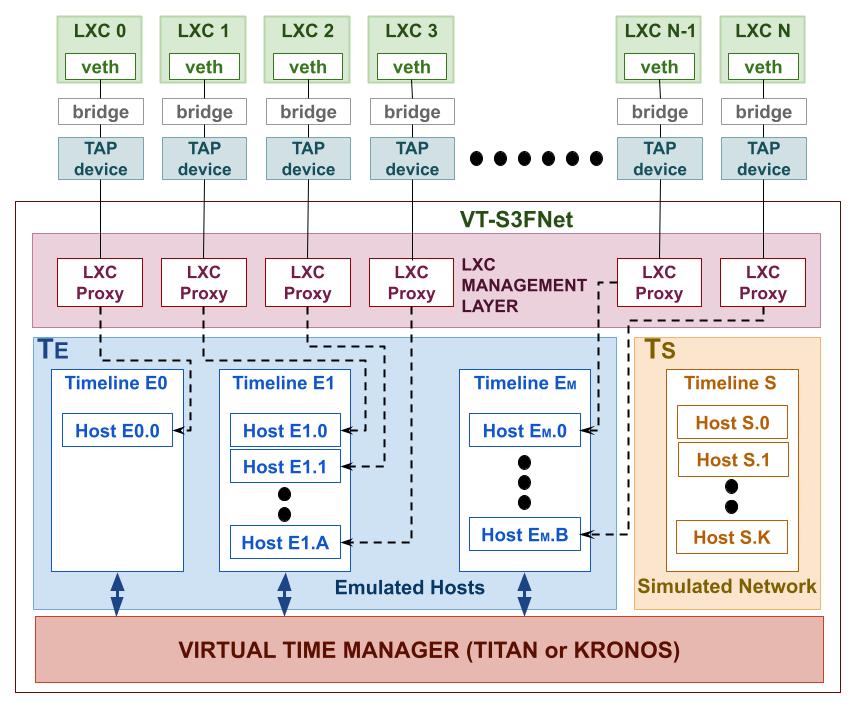
Figure 2. VT-S3FNet architecture
Figure-2 shows the architecture of the virtual time integrated S3FNet implementation. It supports co-simulation. Emulated hosts are aligned on a group of timelines (TE) while the simulated network (simulated hosts + routes) are aligned on a separate timeline (TS). Timelines in TE interact with the virtual time manager (Titan or Kronos) for synchronized execution.